Okay
By Friday morning, the silence had turned into furniture in the house. It sat everywhere. On the kitchen counter. Beside the kettle. In the bathroom while we brushed our teeth side by side without speaking. On the bed between us at night, stretched long and stiff under the duvet.
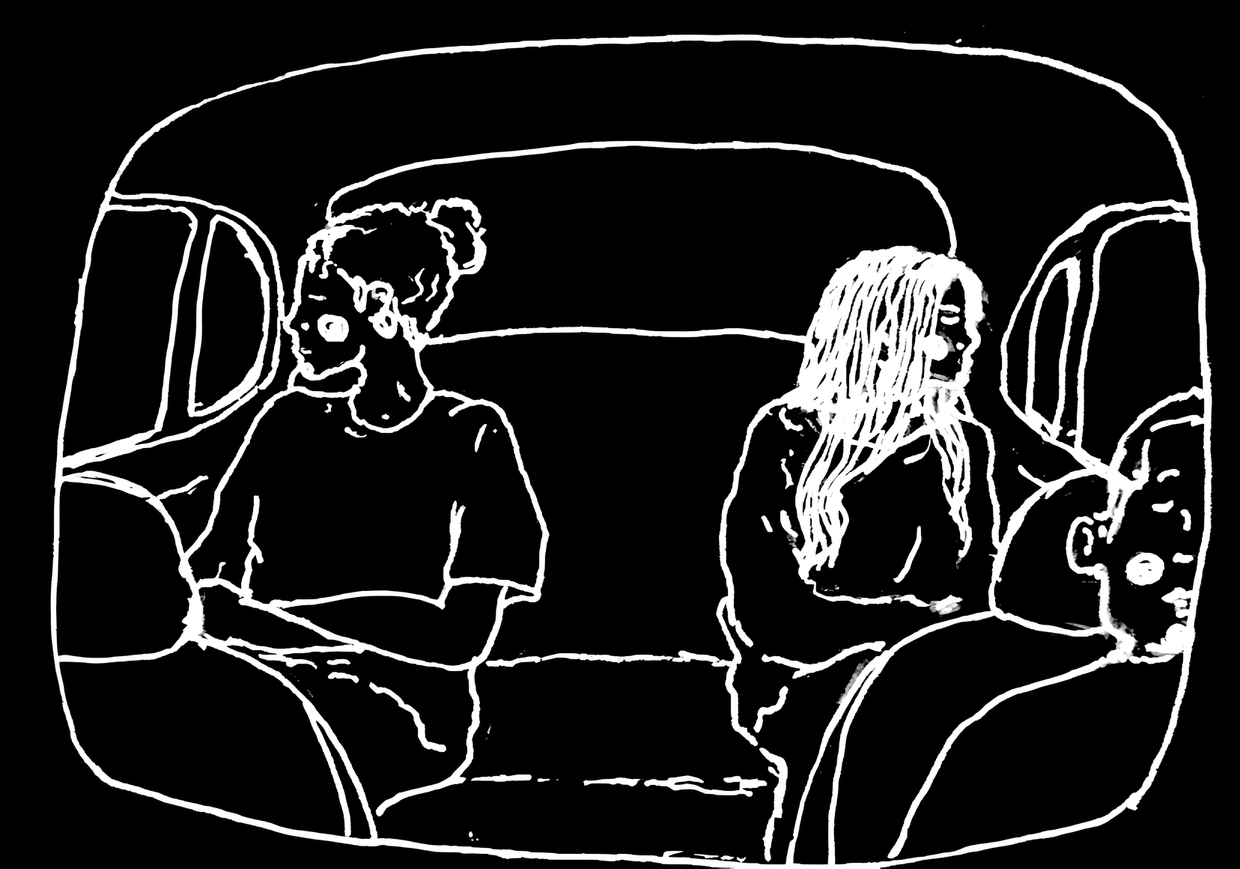
N was already in the backseat when I got in, which meant she had taken the window seat on purpose, which meant she was pressed against the door as far from me as she could, which meant this was going to be a very long ride to East Legon.
I sat down. I put on my seatbelt. The driver said, "Good morning," and neither of us answered him at first. I usually would have answered immediately. I was often the one who spoke to strangers for us, the one who ordered the food, answered the driver, asked the questions. Even at the house we were going to see, I knew I would be the one talking to the agent.
But I hesitated.
Three days of not speaking to N had made even the smallest things feel like they needed permission. When N didn’t answer either, the silence started to feel rude.
“Good morning,” we chorused.
We both turned towards each other.
It wasn’t funny.
Normally, when we said the same thing at the same time, one of us would laugh. Sometimes we’d point it out and say, “See? Same brain.” This time neither of us smiled.
The driver looked at us in the rearview mirror.
I looked away.
He started driving.
N had her phone out. It felt like the scrolling of someone who needed their hands busy so they wouldn’t have to think about sitting 12 inches away from the lover they were not speaking to. I know this because when she's truly interested in her phone, her thumb slows down. But now, it was in a sprint.
I looked out the window; Accra was delightfully busy this particular morning. People moving as if they had somewhere they were late to. A woman stands beside a metal tray of bofrot, lifting them carefully with a pair of tongs to slip into small plastic bags for a waiting customer. Nearby, a man roasts plantain over a small charcoal fire, turning them slowly, smoke blowing into his face. A trotro passes with ‘YƐNFA BEER SIKA NTC ASAASE’ painted across its dusty back in scraggly white letters.
We had printed the listing. When I sent N the link, she sent back "ok."
Not "ok!" Not even "okay." Just "ok." That was the most we had communicated since Wednesday. The listing was in my hand. Three bedrooms. Two baths. "Serene neighbourhood." Every listing in Accra said serene neighbourhood. I don't know what that means. Maybe it means there's no open gutter in front of the gate.
We turned onto the highway; a trotro cut in front of us, and the driver made a sound, hissing sharply through his teeth. Then he gave the steering wheel a small, angry slap. N looked up from her phone for a second, and then looked back down. I almost said "Did you see that?" because it was the kind of thing we said to each other. But the gap is very wide when you have not been talking to someone for three days. Traffic near Shiashie was terrible. We barely moved for twenty minutes. More time to sit in this unfamiliar awkwardness.
Here is the thing about Tuesday.
N had been talking for almost twenty minutes about South Africa. About xenophobia. About African immigrants getting blamed for everything. About videos she had watched of people’s shops being destroyed. About how nobody cared until it became impossible to ignore. She spoke the way she always did when something got under her skin, like she was trying to hand you the exact weight in her chest.
No touching. No jokes. No random kisses in the kitchen while waiting for food. At night, she slept facing the wall. I knew because I stared at her back for hours.
I was tired. Work had annoyed me all day, and the movie was finally getting interesting, and I said, casually, stupidly, “I think you’re obsessing over this.”
N went quiet immediately, and after a few seconds, said, “You just hate hearing me talk.” Which felt insane to me because that was not what I meant at all.
But she had already picked up her phone.
I remember the brightness of the screen on her face more than anything else. Blue light on her textured cheeks; it seemed like she had freshly popped a pimple. The TV kept playing loudly in the background. I watched the rest of the movie alone as she scrolled silently beside me. Now and then, I heard her sniff like she was annoyed or holding something in.
I apologised on the evening of the next day. A real apology, I thought. I told her I was wrong to use that word, that I should have just said I was tired instead of making it about her. She said, "It's fine," and smiled, and it felt like the smile of someone who has decided it is, in fact, not fine but had also decided they were not going to explain why at this moment, possibly ever.
Everything between us turned painfully polite afterwards.
“Can you pass me the charger?”
“Did you lock the door?”
“What time are we leaving?”
The driver turned off the main road. As we slowed into a narrow street, I could see that the listing photo was taken from a very specific angle. The house had looked enormous online. The front yard in the pictures seemed wide enough for two cars, a small garden, and a family of five. N shifted in her seat, uncrossed her legs, and crossed them the other way. I could feel the movement even though I was not looking at her.
We passed a woman selling plantain by the roadside, and I thought N was going to say something because she always says something when she sees someone selling plantain by the roadside ;something about the economy, something about informal labour; she had opinions about everything, and normally I loved it. Normally, her opinions are the most alive part of any room she's in.
She didn't say anything.
I looked at the listing again. There was a photo of the kitchen. The countertops were nice.
"The agent says the gate is green," I said.
I don't know why I said that. It was on the paper; we were both going to see the gate. The information was not urgent. But I said it.
N looked up.
"Okay," she said.
Not hostile. Not warm. Just okay.
We found the gate. It was green. We got out of the car, and the agent was there, a young man in a blue shirt who shook both our hands and said, "You will love this place," with the confidence of someone who says the same thing about every place. We walked in. The gate was much closer to the road. The driveway was narrow, with a high wall on one side and an unfinished building peeking over the other. The front windows looked smaller. Even the porch seemed to have lost several feet on the journey from the internet to real life. The compound was neat. Someone had recently watered the flowers along the path, because the ground was still dark around them.
N stopped and looked at them. I stopped behind her and watched her looking at them.
The agent was saying something about the landlord being flexible with the lease, and I was nodding, but I was watching N because she had tilted her head at the flowers. I recognised that tilt. That was the tilt of someone who was letting something be nice. That was the tilt of someone who was, despite everything, still here.
We went inside. The living room had good light coming in through two wide windows at the front, and recessed light bulbs in the ceiling that made the place look finished. The living room opened into a dining area and then into the kitchen, with a short counter separating the spaces. N walked to a window and stood for a moment. I walked over and stood near her, not right beside her, but near, and we both looked at the small yard. The window looked out over a small rectangular yard behind the house, enclosed by the compound wall. There was a clothesline in one corner and a narrow strip of soil along the wall where someone had planted two young shrubs.
We both looked at it.
"There's space for a garden," she said.
She didn't say it to me. She said it to the window. But she said it.
"Yeah," I whispered back.
The agent smiled like he had closed the deal. He hadn't. We both knew we weren't deciding on anything today. We walked through the rest of the house, mostly separately, me in one room, N in another, occasionally passing each other in the hallway in a way that required one of us to step slightly sideways.
In the master bedroom, there was a crack in the ceiling above the window. N saw it. She was going to say something to me about it. She stopped herself, then she said it anyway:
"That's going to be a problem in the rainy season."
"I know," I said.
She nodded and walked out.
The bedrooms were smaller than they looked in the video.
The second bedroom could fit a bed and a wardrobe, but probably not both without somebody having to turn sideways. The master bedroom had enough room for a bed and two small side tables, but the wardrobe doors opened so far into the room that whoever designed it had clearly never tried to get dressed in a hurry. N tested the bathroom door. It made a loud scraping sound against the floor.
She looked at me.
I looked at her.
For half a second, I thought she was going to laugh.
I wanted to laugh too.
Neither of us did.
On the way back, we got a different driver. This one had the radio on, some presenter on Joy FM talking about traffic, and neither of us asked him to change it, so we just sat with it. N had put her phone in her bag this time. She was looking out the window at things we passed.
After a while, she said, without turning from the window: "My appointment is Saturday. For the tooth."
"I know," I said. "I'll take you."
She didn't say “thank you.” She didn't say “you don't have to.” She just said "okay" and kept looking out the window. But this okay was different. This “okay" had some spiritedness. Some actual meaning underneath it.
I looked out the window.
We didn't talk for the rest of the ride. But it was a different kind of not talking. It was the kind of not talking where both people sit with something they're not ready to say yet, which is different from not talking, because one already said the wrong thing.
N stopped and looked at them. I stopped behind her and watched her looking at them.
On Saturday morning, I drove her to the clinic. She was nervous. She always got nervous about medical things. She never admits it; she just becomes very quiet and picks at the skin around her thumbnail. I didn't say anything about it. I just drove.
In the waiting room, she sat next to me, and after a few minutes, she put her head on my shoulder. Not dramatically. Just rested it there like she was putting something down.
I said nothing.
We sat like that until they called her name. She was in there for forty minutes. When she came out, her face was slightly swollen on one side. She held a piece of gauze in her mouth and looked at me. Her eyes were a little watery, probably from the procedure, probably just from the procedure.
We walked to the car. I opened the passenger door for her. She got in.
I got in on my side.
"How was it?" I asked.
She moved the gauze a little and said, very carefully around the numbness: "Terrible."
And I laughed. Not because it was funny, but because she said it exactly the way she says everything, and because for the first time since Tuesday night her voice was not calibrated. It was just her voice.
She looked at me laughing, her eyes warmer, and said, "Don't make me laugh, it hurts."
So I stopped. I tried to.
She leaned on the headrest and closed her eyes. I started the car.
I still hadn't fully explained myself about Tuesday. She probably still had more to say about it too. The house had a crack in the ceiling. Nothing was resolved.
But I drove, and she rested, and the city moved around us.
Buy Mismemories Here.
About the Writer
Yaa Boahemaa[they/she] is a Ghanaian-Lebanese writer, linguist, and feminist and queer organiser whose work explores intimacy, identity, memory, relationships, and the everyday experiences of young people. Her writing often sits at the intersection of the personal and the political, with an interest in the quiet moments and complicated emotions that shape how people understand themselves and one another.